
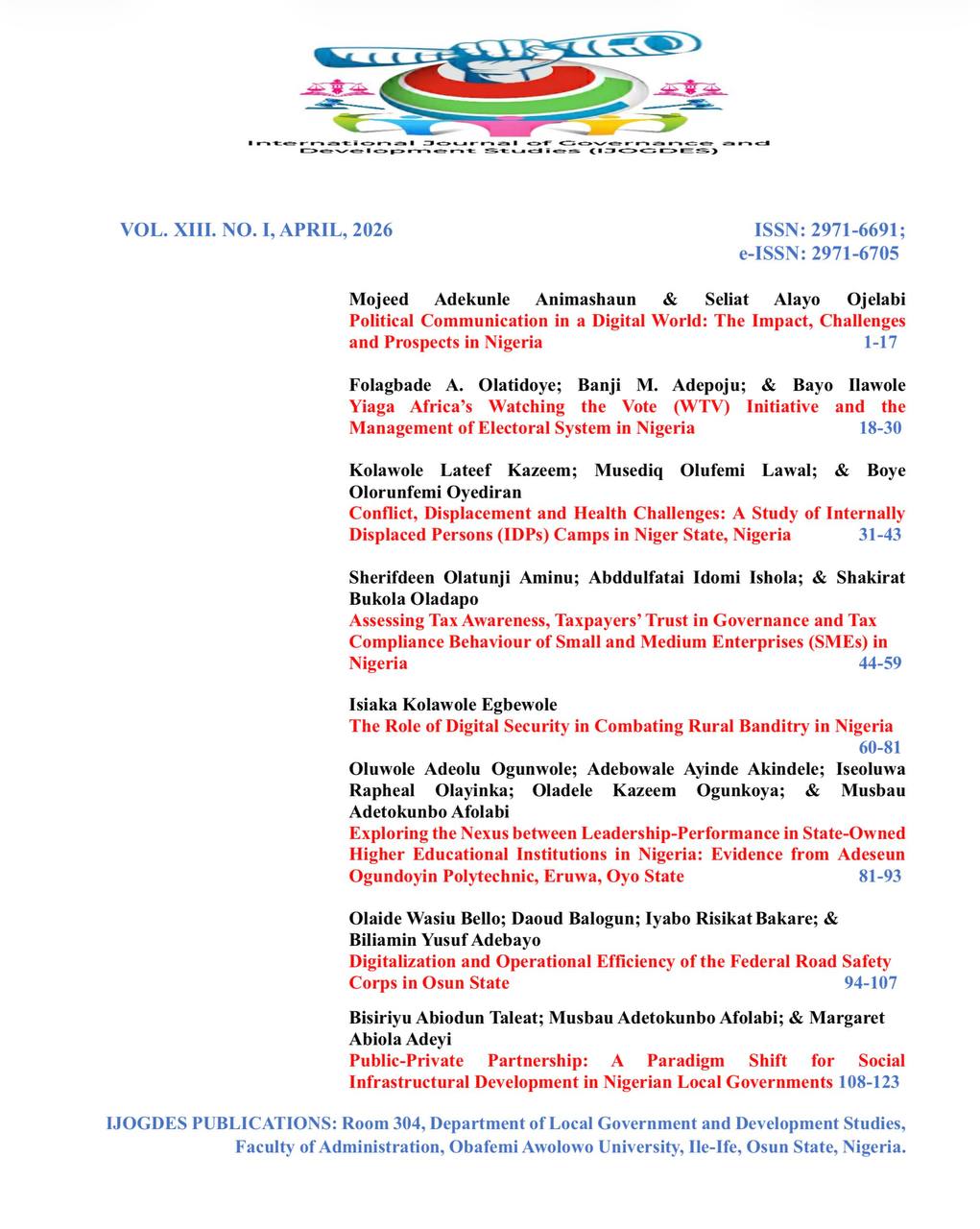
Public-Private Partnership: A Paradigm Shift for Social Infrastructural Development in Nigerian Local Governments
Keywords:
Public-Private Partnership, Social Infrastructure, Development, Local GovernmentAbstract
The Nigerian local government is constituted to provide basic social services like primary health, education, rural roads, water and sanitation. Nevertheless, their success has been hampered by chronic fiscal deficit, low institutional capacity, political interference and excessive dependency on federal allocation leading to colossal infrastructural shortages and inefficiencies in service delivery. In response, Public–Private Partnerships (PPP) emerge as an alternative form of governance and financing strategy aimed at utilizing private sector resources, experience, and productivity to supplement the public sector’s functions. The paper assessed the use of PPPs as a paradigm shift to improve the social infrastructures development, through a multi-stage sampling method, nine local governments in three states were sampled, i.e., Ogun state, Oyo state and Osun state, whereby 270 respondents were investigated through questionnaire administration, while 252 valid responses were analyzed using descriptive statistics, chi-square test and multiple regression analysis. The results indicate that there is high awareness (78.6%) and preference (72.6%) towards the PPP-based infrastructure delivery. The mean score analysis revealed that PPPs increased the quality of road construction, health care facilities, education facilities, project sustainability and service efficiency significantly. Inferential evidence indicates that there is a significant correlation between PPP participation and infrastructure results (2 = 28.47, p < .001), whereas regression analysis reveals that 50 percent of differences in development performance is explained by the three variables including private funding, technical expertise, and risk-sharing. Despite these, corruption, political intervention and poor legal systems are major challenges of PPP. The study finds that PPPs is a potential and efficient tool to address local infrastructural gap, although institutional reforms, transparency and capacity building should be reinforced to make the system sustainable and accountable.
Published
How to Cite
Issue
Section
License
Copyright (c) 2026 International Journal of Governance and Development Studies (IJOGDES)

This work is licensed under a Creative Commons Attribution 4.0 International License.
The copyright holder—namely, the authors of all published articles—grants usage rights to others under an open license (CC BY license). The majority of open access publications are made available through Creative Commons licences. These licences stipulate specific conditions for how works can be adapted, shared, or reused. Specifically, all IJOGDES published articles are licensed under the CC BY license.