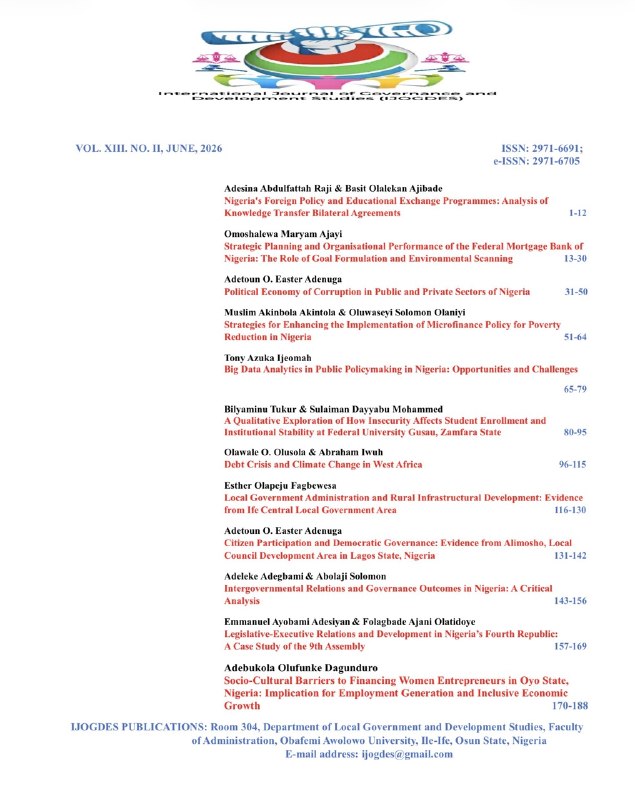
Nigeria's Foreign Policy and Educational Exchange Programmes: Analysis of Knowledge Transfer Bilateral Agreements
Keywords:
Bilateral Agreements, Educational Exchange, Foreign Policy, Intellectual Capital Development, Knowledge TransferAbstract
Undoubtedly, education plays a crucial role in a nation's swift progress, growth, and development. But no country has the right to claim sole possession or expertise in education. Nigeria's educational exchange programmes and wider knowledge transfer have always been shaped by its foreign policy. In particular, bilateral agreements between Nigeria and other countries are the focus of this research of how Nigeria's foreign policy affects attempt for educational exchange. This study illustrates how diplomatic relations have either facilitated or hindered access to international educational opportunities and the transfer of skills and information by looking at important agreements. The study also looks into the political and socio-economic factors that affect these initiatives and how they affect the growth of Nigeria's intellectual capital. To interrogate the issues critically, the study adopts Social Capital Theory to interrogate the discourse while relying on secondary sources to gather the needed information. The preliminary finding reveals a complex analysis of how well these bilateral educational exchanges support national development and recommends solutions for boosting Nigeria's participation in international knowledge sharing, by focusing on integration and collaboration.
Published
How to Cite
Issue
Section
License
Copyright (c) 2026 International Journal of Governance and Development Studies (IJOGDES)

This work is licensed under a Creative Commons Attribution 4.0 International License.
The copyright holder—namely, the authors of all published articles—grants usage rights to others under an open license (CC BY license). The majority of open access publications are made available through Creative Commons licences. These licences stipulate specific conditions for how works can be adapted, shared, or reused. Specifically, all IJOGDES published articles are licensed under the CC BY license.