
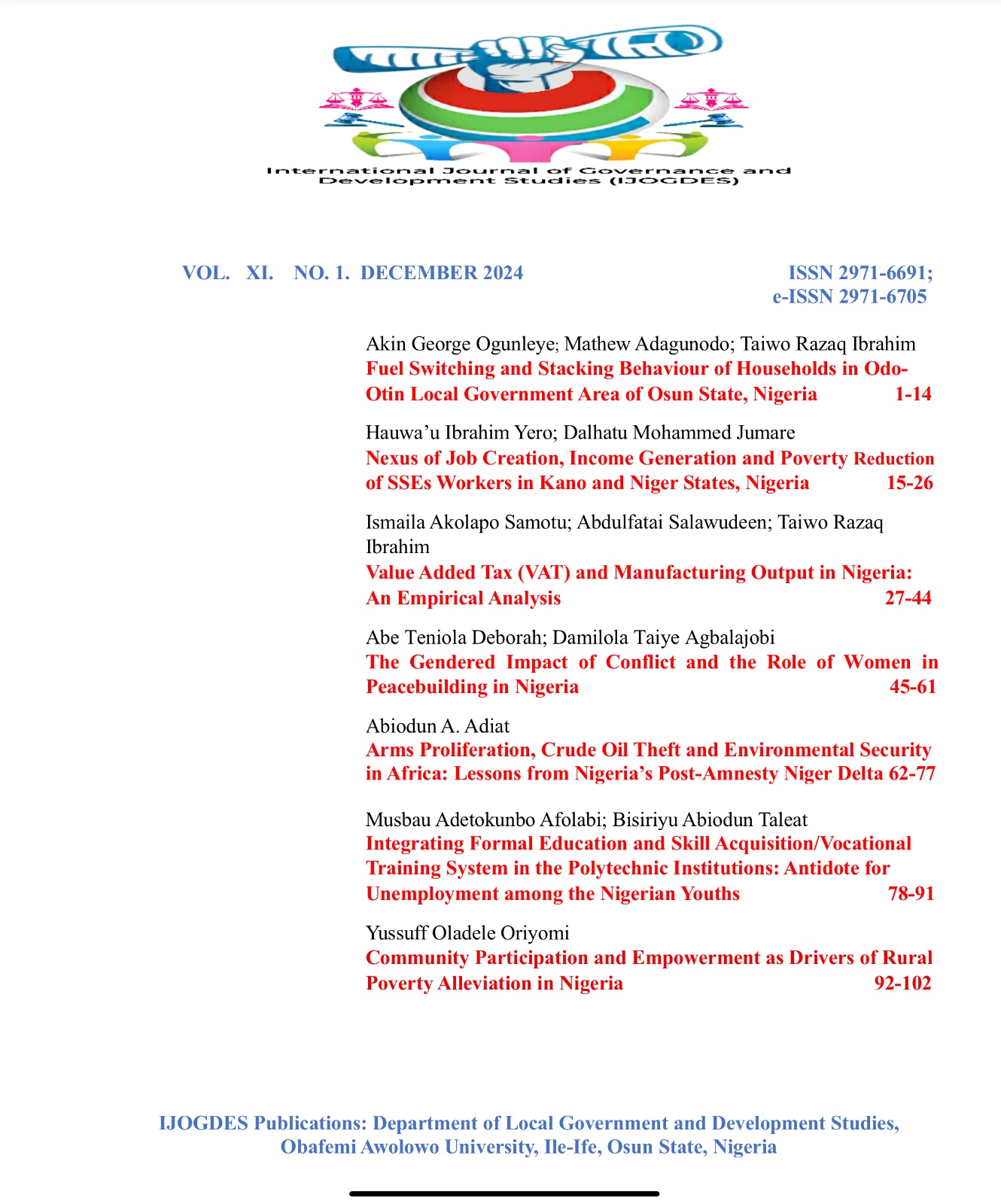
Community Participation and Empowerment as Drivers of Rural Poverty Alleviation in Nigeria
Keywords:
Community Participation, Empowerment, Poverty Alleviation, Sustainable Development Goals, Millennium Development GoalsAbstract
This paper examines the impact of community participation and empowerment in alleviating rural poverty in Oyo State, Nigeria. The key aim is to evaluate the impact of inclusive community-based strategies on sustainable development and their correspondence to the Sustainable Development Goals (SDGs). The paper uses a quantitative research method, where it undertook a survey of 300 respondents to obtain a multifaceted understanding of community involvement, social cohesion, and access to services. As the results show, active community engagement can promote ownership, lead to increases in household income, and social cohesion, particularly when women and youth are part of it. There are, however, challenges like elite capture, socio-cultural barriers, low institutional capacity, and inadequate integration in formal structures of governance that hinder sustainability and inclusiveness. In spite of these challenges, community-based development programs, such as LEEMP or
CSDP, have proven to have constructive effects on infrastructure and service provision. The researchers find that participatory, inclusive strategies are the key to sustainable development in the rural areas. It has been suggested to make it more transparent, include gender interests in it, increase capacity building, and enhance the interaction of community and governmental institutions. Such steps will play a critical role in providing equitable and sustainable development that is responsive to rural poverty and is in line with SDG goals, which will subsequently result in resilient and empowered communities in Oyo State.
Downloads
Published
How to Cite
Issue
Section
License
The copyright holder—namely, the authors of all published articles—grants usage rights to others under an open license (CC BY license). The majority of open access publications are made available through Creative Commons licences. These licences stipulate specific conditions for how works can be adapted, shared, or reused. Specifically, all IJOGDES published articles are licensed under the CC BY license.