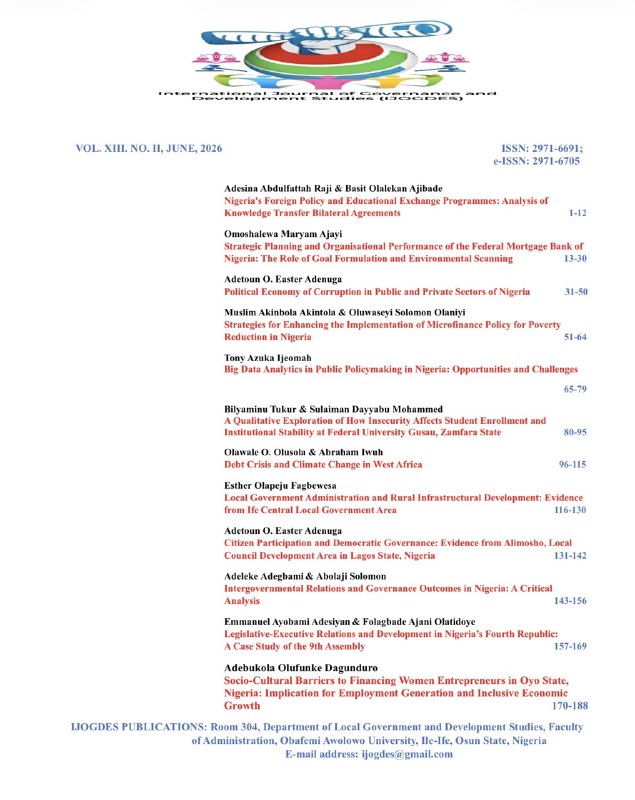
Political Economy of Corruption in Public and Private Sectors of Nigeria
Keywords:
Governance, Patronage, Rent-Seeking, Transparency, Resource-Dependent EconomyAbstract
This study aims to analyze the political economy of corruption in both the public and private sectors in Nigeria, with specific reference to its forms, causes, and effects in those sectors. Generally, corruption as a socio-economic problem affects Nigeria’s development in various ways, including undermining its institutions, misallocating resources, and sustaining inequalities. With reference to political economy theories, this study aims to evaluate the forms and causes of corruption in Nigeria’s sectors, including in the public sector, particularly with reference to rent-seeking behavior in the forms of embezzling government funds and procurement frauds. In the private sector domain, the research examines the interplay between collusion, bribery, and unethical business practices in relation to corruption in the public sector, which creates a symbiotic effect that sustains systemic corruption. The research on corruption reveals the key factors that contribute to corruption, including regulatory frameworks, socio-cultural factors, and economic factors, which are a result of a resource-based economy. By using a robust quantitative research methodology that always produces reliable results in a tabular form, the research reveals the interrelated effects of corruption in the public and private sectors on governance, economic growth, and the public. The study’s findings emphasize the need for comprehensive reforms in terms of strengthening institutional accountability, transparency, and public-private partnerships in the fight against corruption. The study adds to the existing discourse on anti-corruption strategies in resource-endowed developing economies. The study provides recommendations based on Nigeria’s peculiar sociopolitical environment.
Published
How to Cite
Issue
Section
License
Copyright (c) 2026 International Journal of Governance and Development Studies (IJOGDES)

This work is licensed under a Creative Commons Attribution 4.0 International License.
The copyright holder—namely, the authors of all published articles—grants usage rights to others under an open license (CC BY license). The majority of open access publications are made available through Creative Commons licences. These licences stipulate specific conditions for how works can be adapted, shared, or reused. Specifically, all IJOGDES published articles are licensed under the CC BY license.