
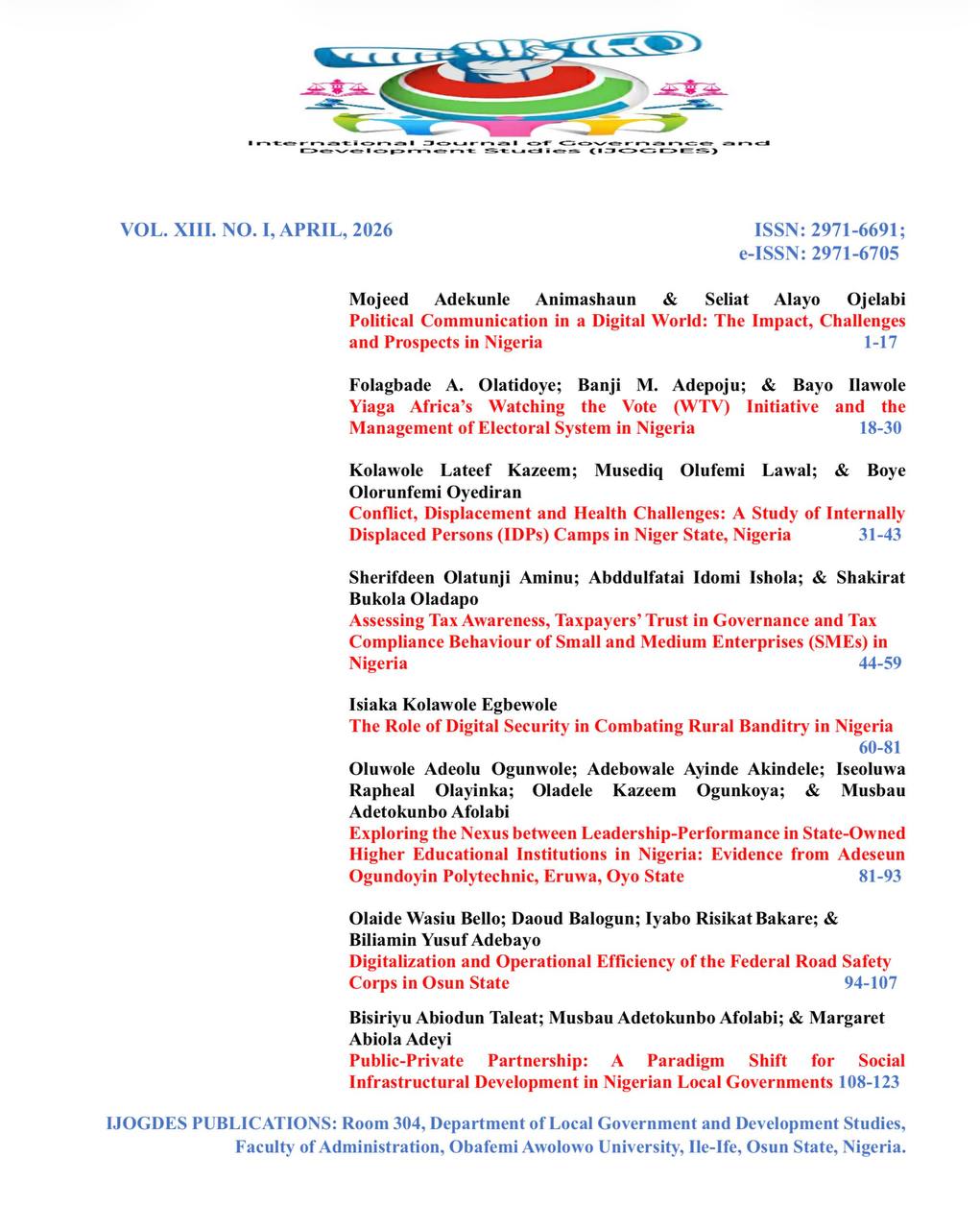
Yiaga Africa’s Watching the Vote (WTV) Initiative and the Management of Electoral System in Nigeria
Keywords:
Electoral Transparency, Legitimacy, Civil Society, NigeriaAbstract
In the Fourth Republic of Nigeria, the electoral malpractice and influence of the elite have perpetuated a disconnect between official reforms and popular trust in the country despite the legal reforms and electoral governance inventions. Transparency, especially through civil society activities, especially the Watching the Vote project by YIAGA Africa based on Parallel Vote Tabulation, have helped to curb the issue of legitimacy, though not completely, during disputed elections. This paper challenges the potential and flaws of the WTV as a transparency mechanism in the governance of the election process in Nigeria. The study methodologically uses secondary data, official election outcomes and PVT reports by WTV on the 2015, 2019 and 2023 general elections. It is analyzed in the context of the electoral governance theory which along with it deciphers the way in which civil society serves as a checkpoint to electoral governance dominated by the state and shows the structural limitations of reforms. This paper found that the WTV has achieved remarkable progress in enhancing electoral transparency, but institutional frailty, elite obstruction and judicial scandals compromise its efficacy in establishing legitimacy. It concludes that though WTV is a needed innovation, voter legitimacy in Nigeria eventually depends on more institutional change, more INEC independence, voter ownership of changes, and voter education in the long-term.
Published
How to Cite
Issue
Section
License
Copyright (c) 2026 International Journal of Governance and Development Studies (IJOGDES)

This work is licensed under a Creative Commons Attribution 4.0 International License.
The copyright holder—namely, the authors of all published articles—grants usage rights to others under an open license (CC BY license). The majority of open access publications are made available through Creative Commons licences. These licences stipulate specific conditions for how works can be adapted, shared, or reused. Specifically, all IJOGDES published articles are licensed under the CC BY license.