
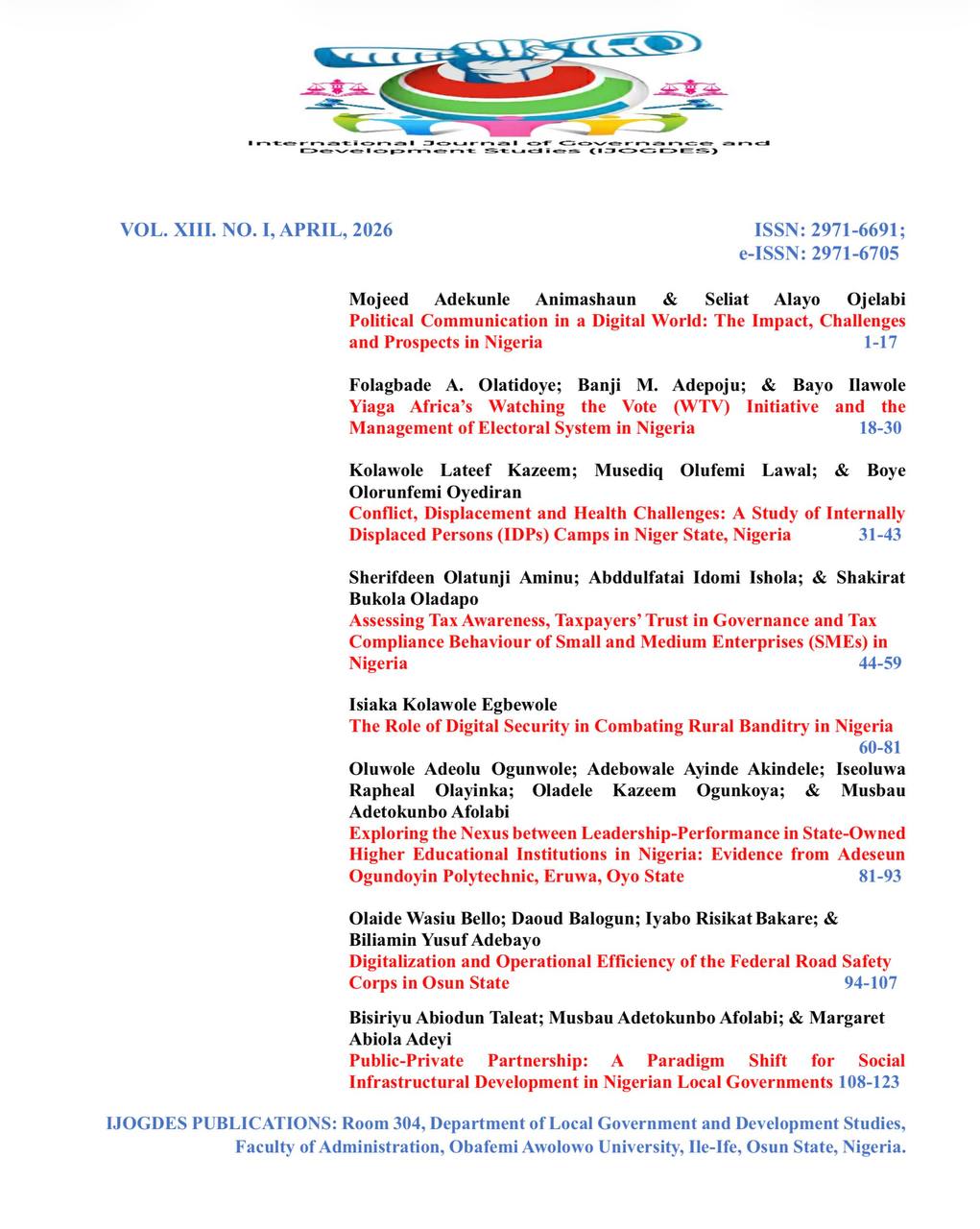
Political Communication in a Digital World: The Impact, Challenges and Prospects in Nigeria
Keywords:
Political communication, Democracy, Election, Digital tools, NigeriaAbstract
The Information and Communication Technology (ICT) revolution has considerably redefined political communication in Nigeria as elsewhere. Inspired by the potential massive electoral rewards associated with digital communication in contemporary electoral challenge, Nigerian politicians and political parties have since latched on to the use of digital tools for their political and or citizen engagements. Trends in this digital transformation, particularly the evolving use of social networking platforms have come to be appreciated in the political landscape, given their transformative effects in the pre and post electoral processes. This study investigates the use of digital outlets by politicians and political parties for voter mobilization in the 2023 presidential election in Nigeria. The paper interrogates the trends, dynamics, and impact of digital tools on the electoral aspirations and chances of electoral contenders during the period under review. Adopting a qualitative content analysis of campaign/propaganda materials and official party communication as well as using 3 political parties as analytic references, the paper explores the extent to which the three parties leveraged on digital tools such as FaceBook, X, and Instagram to electorally outwit one another and to stay in the consciousness of the voting public. The paper finds that while one of the three selected party labels aggressively utilized digital outlets for voter mobilization particularly in the 2023 presidential challenge, the efforts did not result into decisive electoral triumph for the party. The paper also identifies limitations to the mainstreaming of digital political communication in Africa’s largest electoral democracy. It concludes by proposing some recommendations that are capable of addressing the limitations of digitalized political communication in the Nigerian context.
Published
How to Cite
Issue
Section
License
Copyright (c) 2026 International Journal of Governance and Development Studies (IJOGDES)

This work is licensed under a Creative Commons Attribution 4.0 International License.
The copyright holder—namely, the authors of all published articles—grants usage rights to others under an open license (CC BY license). The majority of open access publications are made available through Creative Commons licences. These licences stipulate specific conditions for how works can be adapted, shared, or reused. Specifically, all IJOGDES published articles are licensed under the CC BY license.