
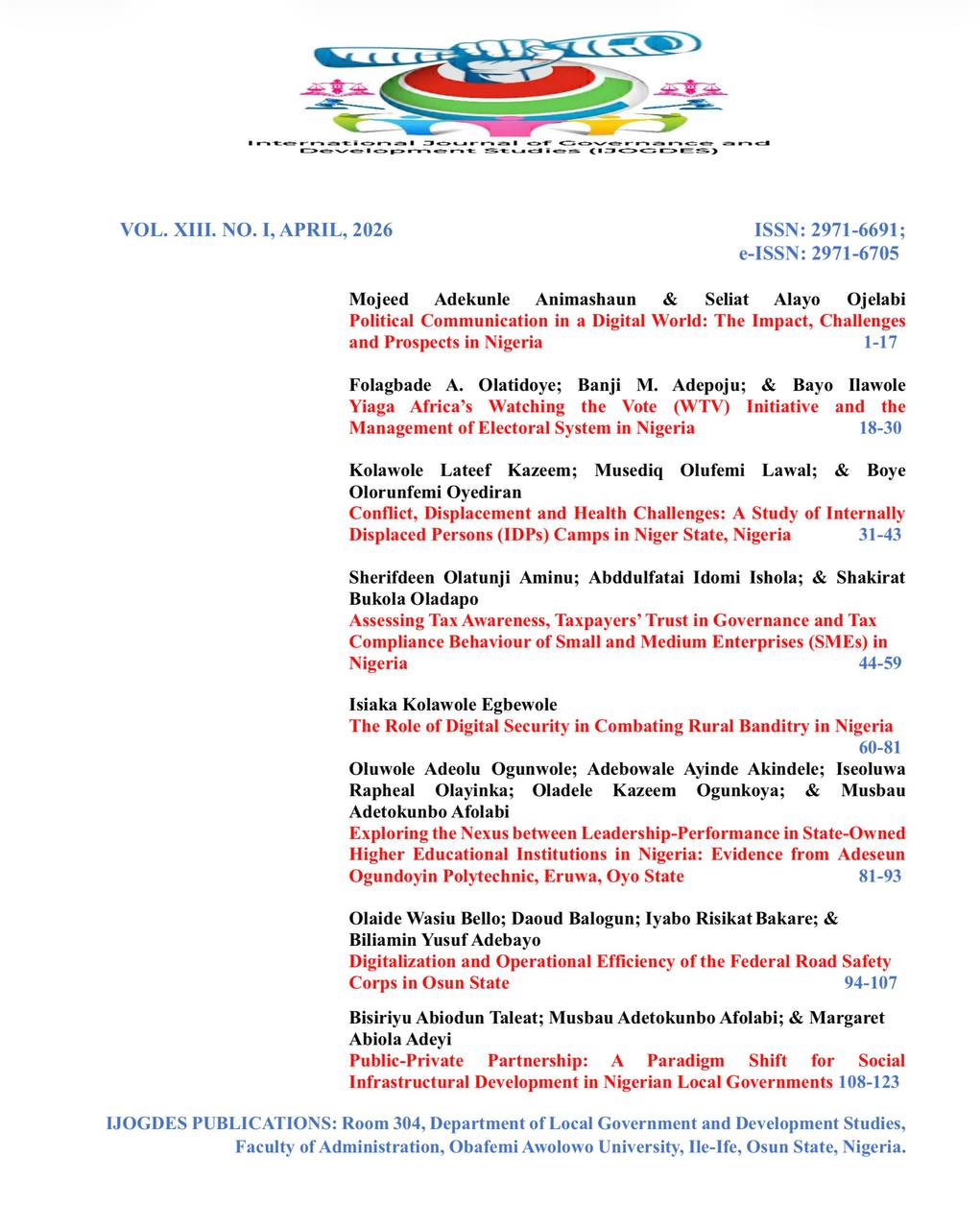
Conflict, Displacement and Health Challenges: A Study of Internally Displaced Persons (IDPs) Camps in Niger State, Nigeria
Keywords:
Internal Displacement, Healthcare Access, Re-integration, Systemic Barriers, Niger StateAbstract
This study examines the multifaceted health challenges faced by internally displaced persons (IDPs) in Nigeria, emphasizing their implications for peacebuilding and social reintegration. Driven by conflicts, insurgencies like Boko Haram, environmental crises, and communal clashes, Nigeria’s internal displacement has escalated significantly since 2014, particularly in Niger State, where thousands are displaced into overcrowded camps with inadequate health infrastructure. The research employs a qualitative phenomenological approach, gathering insights from IDPs, healthcare providers, and policymakers through Key Informant Interviews, focus groups Discussion, and observations within selected camps. Findings reveal pervasive deficiencies in healthcare access, compounded by infrastructural decay, cultural insensitivity, gender disparities, and policy gaps, resulting in low trust and reliance on informal treatments. Displaced individuals report ongoing physical ailments, mental health trauma, and social stigmatization. Environmental conditions, systemic neglect, and sociocultural barriers exacerbate health disparities, fueling resentment and social fragmentation. The study underscores that health is integral to human security and societal stability, advocating for comprehensive policies that integrate culturally sensitive healthcare, mental health support, and community participation into peacebuilding frameworks. Addressing these systemic and cultural barriers is essential for sustainable recovery, social cohesion, and long-term peace in conflict-affected Nigeria.
Published
How to Cite
Issue
Section
License
Copyright (c) 2026 International Journal of Governance and Development Studies (IJOGDES)

This work is licensed under a Creative Commons Attribution 4.0 International License.
The copyright holder—namely, the authors of all published articles—grants usage rights to others under an open license (CC BY license). The majority of open access publications are made available through Creative Commons licences. These licences stipulate specific conditions for how works can be adapted, shared, or reused. Specifically, all IJOGDES published articles are licensed under the CC BY license.