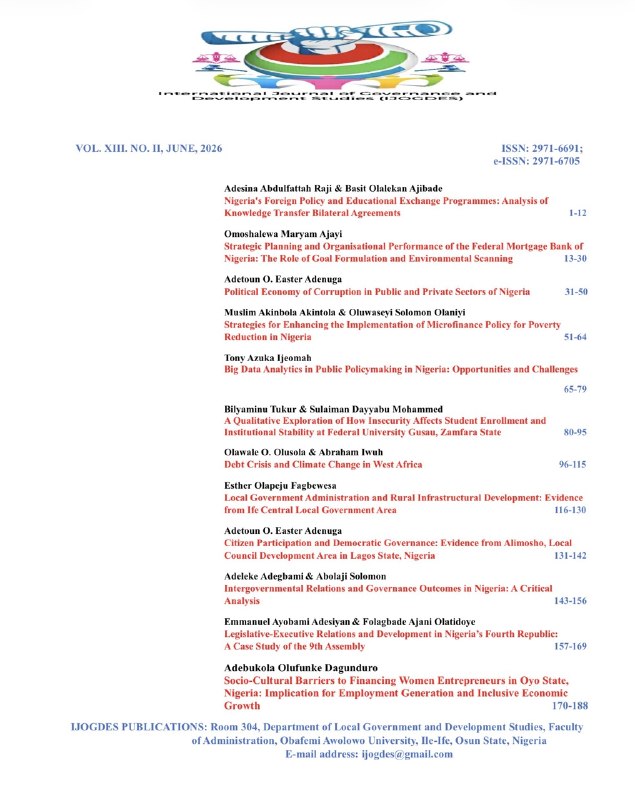
Intergovernmental Relations and Governance Outcomes in Nigeria: A Critical Analysis
Keywords:
Intergovernmental Relations, Governance, Federalism, Fiscal Centralisation, Nigeria, Local GovernmentAbstract
The study examines intergovernmental relations in Nigeria, how they have influenced the management of interactions among different levels of government in the country, and how their structural features have either strengthened or undermined the country’s governance. The study adopted a qualitative and descriptive approach, drawing data from secondary sources, including constitutional provisions, textbooks, scholarly journals, official reports, and judicial decisions. The data gathered were analysed using content analysis. The study reveals that Nigeria’s intergovernmental relations are characterised by over-centralisation of powers, fiscal dependency of subnational governments, constitutional ambiguities, and weak local government systems, among others. These structural defects have fostered policy incoherence, fiscal imbalance, limited autonomy at subnational levels and conflicts, thereby inhibiting effective service delivery, national development and the country’s governance. Furthermore, the imbalances and excessive federal dominance have weakened subnational autonomy and hindered participatory governance. The study, therefore, concludes that while Nigeria’s federal structure is constitutionally planned to foster shared governance, coordination, and cooperation among the federating units of government, its practical operation reveals deep-seated challenges that undercut these ideals. As such, Nigeria’s governance challenges were deeply linked to the dysfunctional nature of its intergovernmental relations. The study recommends
that Nigeria must pursue federalism through constitutional restructuring, fiscal decentralisation, and institutional reforms that promote autonomy, cooperation and collaboration among all levels of government.
Published
How to Cite
Issue
Section
License
Copyright (c) 2026 International Journal of Governance and Development Studies (IJOGDES)

This work is licensed under a Creative Commons Attribution 4.0 International License.
The copyright holder—namely, the authors of all published articles—grants usage rights to others under an open license (CC BY license). The majority of open access publications are made available through Creative Commons licences. These licences stipulate specific conditions for how works can be adapted, shared, or reused. Specifically, all IJOGDES published articles are licensed under the CC BY license.