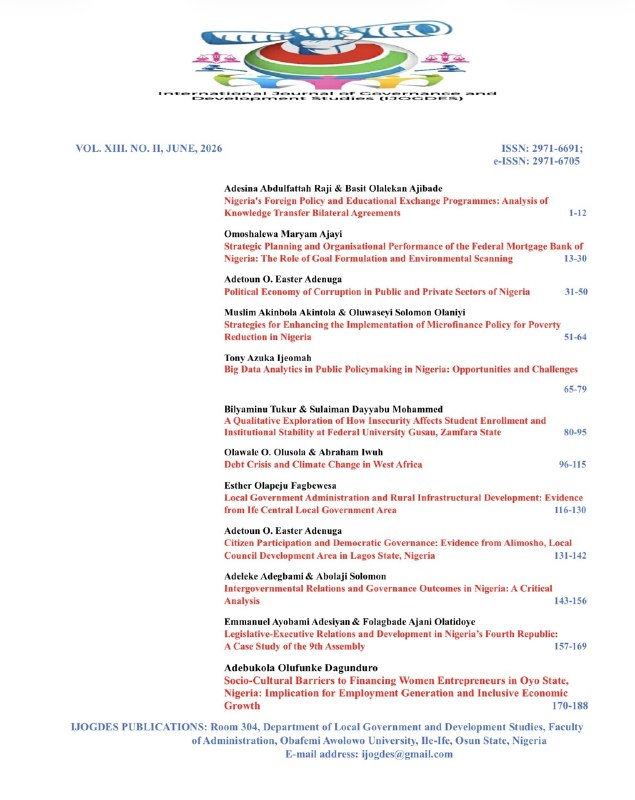
A Qualitative Exploration of How Insecurity Affects Student Enrollment and Institutional Stability at Federal University Gusau, Zamfara State.
Keywords:
Student Enrollment, Institutional Stability, Armed Banditry, KidnappingAbstract
This qualitative study explores the effect of insecurity on student enrollment and its implications for the institutional stability of Federal University Gusau, Zamfara State, between 2019 and 2024. Framed by Resource Dependence Theory and Institutional Theory, the research investigates how security challenges disrupt the University's capacity to attract and retain students as vital resources. The study employed a qualitative design, utilising semi-structured interviews and focus group discussions with 14 purposively selected management staff and 30 students. Data were analysed using thematic analysis. The findings revealed a profound institutional crisis characterised by a generational shift in educational decision-making, where security concerns now outweigh academic reputation, leading parents to actively discourage enrollment at the university. This is compounded by a significant faculty brain drain that has depleted institutional capacity and a severe erosion of academic continuity due to fragmented curriculum delivery. The study validated both theoretical frameworks, demonstrating through qualitative narratives how insecurity disrupted essential resource flows (Resource Dependence Theory) and fundamentally compromised the university's legitimacy and operational stability (Institutional Theory). Specifically, the findings supported Institutional Theory by revealing how coercive pressures from the insecure environment have forced the university to adopt survival strategies that deviate from its core educational mission, while normative expectations regarding safety have been fundamentally altered, diminishing the institution's legitimacy in the eyes of its stakeholders. The
research concludes that insecurity critically undermines the institution's resource base and viability, recommending the development of context-specific security-education partnerships and a sustainable hybrid learning model to restore institutional stability and resource flows.
Published
How to Cite
Issue
Section
License
Copyright (c) 2026 International Journal of Governance and Development Studies (IJOGDES)

This work is licensed under a Creative Commons Attribution 4.0 International License.
The copyright holder—namely, the authors of all published articles—grants usage rights to others under an open license (CC BY license). The majority of open access publications are made available through Creative Commons licences. These licences stipulate specific conditions for how works can be adapted, shared, or reused. Specifically, all IJOGDES published articles are licensed under the CC BY license.